flowchart TB

TCCS{Teoría de la \ncarrera cognitiva\nsocial} --> C[Currícula]

TCCS--> PPG[Pedagogía con \nperspectiva de género]

MR[Acceso a \nmodelos de rol\nfemeninos]

C--->A[Autoeficacia \nniñas]-->BG[Cierre de la \nbrecha de género]

PPG-->A
MR-->A
Resumen
Antecedentes
La subrepresentación de las mujeres en los campos de ciencia, tecnología, ingeniería y matemáticas (STEM) está bien documentada en los países desarrollados y, sin embargo, el debate público sobre las disparidades de género en STEM en China aún se encuentra en su etapa incipiente. El respaldo a las creencias tradicionales sobre los roles de género y la conformidad con las normas sociales son pertinentes para la cultura china, lo que puede incluso exacerbar las disparidades de género en la participación en STEM. Basado en la teoría de la carrera cognitiva social, el presente estudio se basó en una muestra nacional de estudiantes de secundaria (N = 3020) en China para estimar las disparidades de género en la autoeficacia, el interés y las aspiraciones en STEM y examinar cómo las normas culturales y de género influyen en el compromiso con STEM.
Resultados
Se encontró sustento en el modelo de mediación secuencial propuesto, en el que las niñas tenían más probabilidades de mostrar niveles más bajos de autoeficacia que los niños; lo que se asoció con un menor interés en STEM y una menor motivación para seguir carreras STEM. Los resultados también respaldaron el efecto moderador de las creencias tradicionales sobre los roles de género y encontraron que las diferencias de género en la autoeficacia, el interés y las aspiraciones en STEM eran más evidentes entre los estudiantes que respaldaban firmemente las opiniones estereotipadas sobre los roles masculinos y femeninos.
Conclusiones
Los hallazgos ofrecen implicaciones importantes para los esfuerzos por mejorar el acceso de las niñas a la educación STEM a través del enriquecimiento del plan de estudios y programas extraescolares para cerrar la brecha de género en STEM. El acceso a modelos femeninos y a una pedagogía con perspectiva de género también es esencial para impulsar la autoeficacia de las niñas en STEM y erradicar las creencias tradicionales sobre los roles de género entre todos los estudiantes.
Resumen visual
Importante
El trabajo estima un modelo estructural para probar las relaciones hipotéticas entre género, autoeficacia en STEM, interés en STEM y aspiraciones académicas y profesionales en STEM, controlando las variables demográficas (edad, etnia, nivel educativo de la madre y nivel educativo del padre).
Se examina un modelo de mediación moderado (ver Fig. 2) en el que las creencias tradicionales sobre los roles de género (Hipótesis 3) y la conformidad con las normas sociales (Hipótesis 4) moderarían la asociación del género con la autoeficacia, el interés y las aspiraciones académicas y profesionales en STEM.
La socialización del rol de género juega un papel importante en socavar la representación femenina en STEM (Kanny et al., 2014).
Basado en la teoría de la carrera cognitiva social, el presente estudio tuvo como objetivo (1) estimar las diferencias de género en la autoeficacia, el interés y las aspiraciones académicas y profesionales en STEM entre estudiantes de secundaria en China, (2) investigar si la autoeficacia, la eficacia y el interés en STEM explicarían las diferencias de género en las aspiraciones académicas y profesionales en STEM, y (3) examinarían los efectos moderadores de las creencias tradicionales sobre los roles de género y la conformidad con las normas sociales sobre las diferencias de género en la autoeficacia, el interés y las aspiraciones académicas y profesionales en STEM.
Además, los profesores deben identificar y ser conscientes de sus prejuicios de género en las interacciones en el aula (por ejemplo, elogiar a los niños más que a las niñas por su desempeño en tareas STEM, no esperar que a las niñas les vaya bien en matemáticas y ciencias, y asignar a los niños la tarea de ser los líderes en el trabajo grupal relacionado con STEM) (Sadker & Zittleman, 2007).
En general, el presente estudio se suma a la creciente evidencia de disparidades de género en la autoeficacia, el interés y las aspiraciones académicas y profesionales en STEM en China (Lyo, 2018; Yang y Gao, 2019).
Tellhed y colegas (2017) descubrieron que las diferencias de género en el interés en las especialidades STEM pueden explicarse por la menor autoeficacia de las mujeres en STEM.
[1] "Advertisement"
[2] "\n                            \n    International Journal of STEM Education\n\n                            volume 9, Article number: 37 (2022)\n            Cite this article\n                        "
[3] "12k Accesses"
[4] "30 Citations"
[5] "1 Altmetric"
[6] "Metrics details"
Parsing text into sentences and tokens...DONE
Calculating pairwise sentence similarities...DONE
Applying LexRank...DONE
Formatting Output...DONE[1] "After confirming the fit of the measurement model, we estimated a structural model to test the hypothesized relationships between gender, self-efficacy in STEM, interest in STEM, and academic and career aspirations in STEM, controlling for demographic variables (i.e., age, ethnicity, mother’s education level, and father’s education level)."
[2] "In addition, we examined a moderated mediation model (see Fig. 2) in which traditional gender role beliefs (Hypothesis 3) and conformity to social norms (Hypothesis 4) would moderate the association of gender with self-efficacy, interest, and academic and career aspirations in STEM."
[3] "Gender role socialization plays an important role in undermining female representation in STEM (Kanny et al., 2014)."
[4] "Grounded in social cognitive career theory, the present study aimed to (1) estimate gender differences in self-efficacy, interest, and academic and career aspirations in STEM among secondary school students in China, (2) investigate whether self-efficacy and interest in STEM would explain gender differences in academic and career aspirations in STEM, and (3) examine the moderating effects of traditional gender role beliefs and conformity to social norms on gender differences in self-efficacy, interest, and academic and career aspirations in STEM."
[5] "Moreover, teachers must identify and be aware of their gender biases in classroom interactions (e.g., praising boys more than girls for their performance on STEM tasks, not expecting girls to do well in mathematics and science, and assigning boys to be the leaders in STEM-related group work) (Sadker & Zittleman, 2007)."
[6] "Overall, the present study adds to growing evidence of gender disparities in self-efficacy, interest, and academic and career aspirations in STEM in China (Liu, 2018; Yang & Gao, 2019)."
[7] "Tellhed and colleagues (2017) found that gender differences in interest in STEM majors can be explained by women’s lower self-efficacy in STEM." [1] "Tellhed and colleagues (2017) found that gender differences in interest in STEM majors can be explained by women’s lower self-efficacy in STEM."
[2] "Gender role socialization plays an important role in undermining female representation in STEM (Kanny et al., 2014)."
[3] "Grounded in social cognitive career theory, the present study aimed to (1) estimate gender differences in self-efficacy, interest, and academic and career aspirations in STEM among secondary school students in China, (2) investigate whether self-efficacy and interest in STEM would explain gender differences in academic and career aspirations in STEM, and (3) examine the moderating effects of traditional gender role beliefs and conformity to social norms on gender differences in self-efficacy, interest, and academic and career aspirations in STEM."
[4] "In addition, we examined a moderated mediation model (see Fig. 2) in which traditional gender role beliefs (Hypothesis 3) and conformity to social norms (Hypothesis 4) would moderate the association of gender with self-efficacy, interest, and academic and career aspirations in STEM."
[5] "After confirming the fit of the measurement model, we estimated a structural model to test the hypothesized relationships between gender, self-efficacy in STEM, interest in STEM, and academic and career aspirations in STEM, controlling for demographic variables (i.e., age, ethnicity, mother’s education level, and father’s education level)."
[6] "Moreover, teachers must identify and be aware of their gender biases in classroom interactions (e.g., praising boys more than girls for their performance on STEM tasks, not expecting girls to do well in mathematics and science, and assigning boys to be the leaders in STEM-related group work) (Sadker & Zittleman, 2007)."
[7] "Overall, the present study adds to growing evidence of gender disparities in self-efficacy, interest, and academic and career aspirations in STEM in China (Liu, 2018; Yang & Gao, 2019)." 
Parsing text into sentences and tokens...DONE
Calculating pairwise sentence similarities...DONE
Applying LexRank...DONE
Formatting Output...DONE
[1] "ses showed that the magnitude of gender differences in Previous studies have attempted to apply social cogni-\nmathematics and science literacy is minimal (Else-Quest tive career theory to understand students’ STEM engage-\net al., 2010; Lindberg et al., 2010; Stoet & Geary, 2018) ment and development."
[2] "In addition, women are\nliterature on gender differences in STEM engagement, it portrayed as feminine, emotional, and altruistic, and they\nwas hypothesized that: are supposed to be more interested in arts, humanities,\n and social sciences, whereas men are considered mas-\n Hypothesis 1: Girls would show lower levels of self- culine, rational, and competitive, and should be more\n efficacy, interest, and academic and career aspira- interested in STEM (Diekman et al., 2010)."
[3] "The results\n\n\n\nTable 1 Gender differences in self-efficacy, interest, and academic and career aspirations in STEM\n Entire sample Boys (n = 1552) Girls (n = 1463)\n (N = 3020)\n n (%) n (%) n (%)\n\nSelf-efficacy in STEM\n I usually give up when I do not understand a STEM concept* 600 (19.9%) 281 (18.1%) 319 (21.8%)\n I am confident that I can learn STEM subjects well 1485 (49.2%) 934 (60.2%) 549 (37.5%)\n If I work hard enough, I can learn difficult STEM concepts 1919 (63.5%) 1069 (68.9%) 848 (58.0%)\nInterest in STEM\n I enjoy learning about science, technology, engineering, and mathematics (STEM) 1238 (41.0%) 857 (55.2%) 378 (25.8%)\n I really enjoy STEM subjects (e.g., mathematics, biology, physics, chemistry, and infor- 1279 (42.4%) 881 (56.8%) 396 (27.1%)\n mation technology)\n I think STEM lessons are interesting 1381 (45.7%) 893 (57.5%) 486 (33.2%)\nAcademic and career aspirations in STEM\n If I could choose in the future, I would not take any STEM courses* 639 (21.2%) 281 (18.1%) 358 (24.5%)\n If I could get into a college, I would like to study STEM 1132 (37.5%) 812 (52.3%) 318 (21.7%)\n I would like to pursue a STEM-related career in the future 1061 (35.1%) 769 (49.5%) 290 (19.8%)\n*Items are reverse coded\n\nChan International Journal of STEM Education (2022) 9:37 Page 8 of 13\n\n\n\n\nTable 2 Descriptive statistics and correlations of study variables\n 1 2 3 4 5\n\n1."
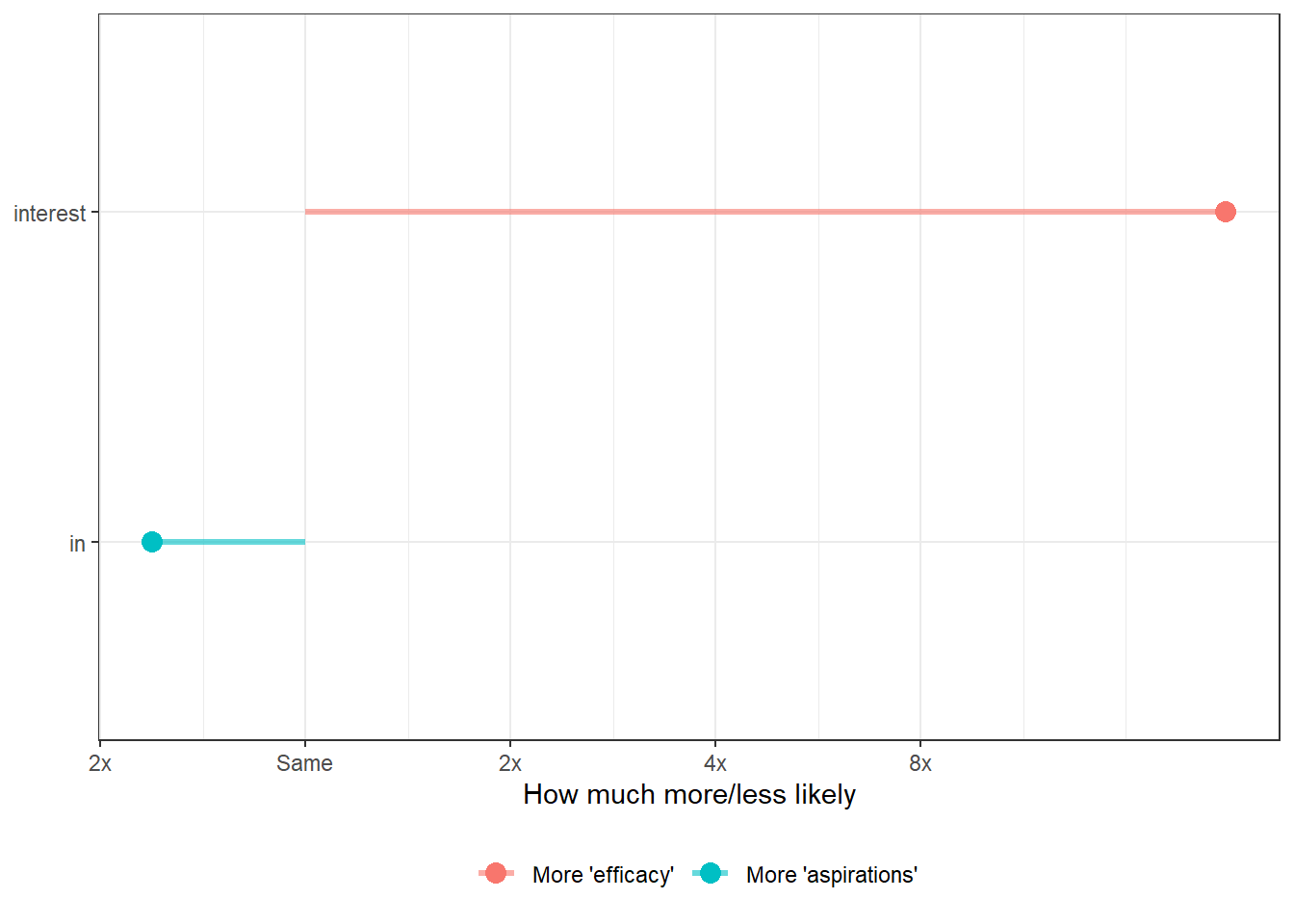
El siguiente gráfico muestra una analogía al estudio “she giggles, he gallops” donde cuentan los bigramas que coinciden con “él X” y “ella X”.
En este caso, buscamos las palabras “efficacy” and “aspirations”
La idea de la relación logarítmica muestra la probabilidad de que aparezca una palabra en comparación con su contraparte (por lo que “efficacy (algo)” tiene aproximadamente 5 más probabilidades de aparecer que “aspirations (algo)”. En este gráfico, reemplazamos las etiquetas del eje x con “2x” y “4x”, pero sin ellos, se obtienen números como 1, 2 y 3 (o -1, -2, -3)). Para convertir esos números de razones registradas a la versión multiplicativa (es decir, 2x en lugar de 1), eleva 2 a la potencia de la razón logarítmica. Si la relación logarítmica es 3, la versión legible por humanos es 2^3, o sea 8 veces.
Referencias
Reutilización
Cómo citar
BibTeX
@online{robano2024,
  author = {Robano, Virginia},
  title = {Resumen del artículo: Una perspectiva sociocognitiva sobre
    las disparidades de género en la autoeficacia, los intereses y las
    aspiraciones en ciencia, tecnología, ingeniería y matemáticas
    (STEM): la influencia de las normas culturales y de género},
  date = {2024-03-22},
  url = {https://ceibal-fichas-genero-stem.netlify.app/posts/autoeficacia/},
  langid = {es}
}
Por favor, cita este trabajo como:
Robano, Virginia. 2024. “Resumen del artículo: Una perspectiva
sociocognitiva sobre las disparidades de género en la autoeficacia, los
intereses y las aspiraciones en ciencia, tecnología, ingeniería y
matemáticas (STEM): la influencia de las normas culturales y de
género.” March 22, 2024. https://ceibal-fichas-genero-stem.netlify.app/posts/autoeficacia/.